“The greatest and most beautiful of all bronze statues” (Antoine-Claude Pasquin –Valery-) 1827
The statue of the Winged Victory of Brescia is one of the most extraordinary bronzes from the Roman era that has survived to this day, a symbol and witness to the very history of the city.
THE HISTORY
It was in 1826 when it was discovered in a cavity of the Capitol temple of ancient Brixia (the Latin name for Brescia), following archaeological excavations conducted by the learned members of the Ateneo di Scienze, Lettere e Arti di Brescia.

The statue lay alongside about eighty worked bronze frames, five heads of Roman emperors, a female portrait, a gilded bronze applique depicting a prisoner, the breastplate of an equestrian statue, and numerous other bronze fragments, now displayed at the Museum of Santa Giulia and the Capitolium.
Notables and men of science attended the event, and as news of the discovery spread, many people began to gather. On July 22, amidst the streets of the city, while the bells rang in celebration, an unusual and festive procession paraded: amidst cheering crowds, the Podestà led the cart with the statue of Victory displayed upright, followed by the military band and the authorities of the time.
The bronze depicts a winged female figure, just under two meters tall (194 cm), with a posture now incomplete due to the loss of some elements that completed its gesture and position of balance; the left foot was likely resting on the helmet of Mars, the left arm was supposed to hold a shield, also supported by the bent leg, on which the deity had inscribed the name of the victor with a stylus, entrusting it to the bronze and offering it to the view of those who looked at her.

The great bronze statue soon rose to international prominence: beloved by Giosuè Carducci, who celebrated it in the ode To Victory, admired by Gabriele D’Annunzio and Napoleon III, who wanted a copy, the Winged Victory is, in terms of composition, material, and preservation, one of the most important sculptures of Romanity.
The creation of the Winged Victory – we now know – can be dated to the mid-1st century AD and is attributed to a high-level atelier, which managed to create a new and original sculptural model. The technique used is that of lost-wax casting, which requires great skill and technological capability. It may have been a gift from the imperial house to Brixia for the support given in a military event, perhaps the clashes of AD 69 that took place between Brixia and Cremona, among the armies of Otho, Vitellius, and Vespasian, which led the latter to command the empire.
THE RESTORATION AND ENHANCEMENT PROJECT

The Winged Victory before the cleaning operations. Photographic archive of the Opificio delle Pietre Dure and Restoration Laboratories of Florence 
The Winged Victory during the cleaning operations. Photographic archive of the Opificio delle Pietre Dure and Restoration Laboratories of Florence
The project dedicated to this statue is a true enterprise that, after some time, retraces the splendor of its discovery. Indeed, just as in the early decades of the 19th century, thanks to a public subscription, it was possible to conduct archaeological excavations that brought to light the temple and precious artifacts, including the Winged Victory, leading to the opening of the first civic museum of the city, the Museo Patrio in 1830, today civil society and Brescia’s entrepreneurship have rallied around this symbol, which is strongly identity-based, with the aim not only of ensuring its proper conservation but also of deepening its knowledge through highly scientific studies and enhancing its intrinsic qualities in the monumentality of the ancient temple’s hall.
The resources from private donors followed those from public entities such as the Municipality of Brescia, the Brescia Museums Foundation, and the Lombardy Region. This virtuous financing has led to the establishment of a coalition of excellence in the numerous fields that make up the project: research, conservation, protection of the work, engineering, exhibition and lighting solutions, and logistics.
The restoration intervention has been conducted exemplarily, in method and quality, by experts from the Opificio delle Pietre Dure in Florence.
The Vittoria Alata 2020 project is the expression of the best skills and energies that our country can deploy in the field of enhancing archaeological and monumental heritage. These efforts have managed to work, despite the high numbers and logistical difficulties, in a dialectical and constructive manner, driven by the identity value and auspicious significance that the Vittoria Alata has carried since its discovery.
THE CULTURAL PALIMPSEST “VITTORIA ALATA BRESCIA 2020-22”
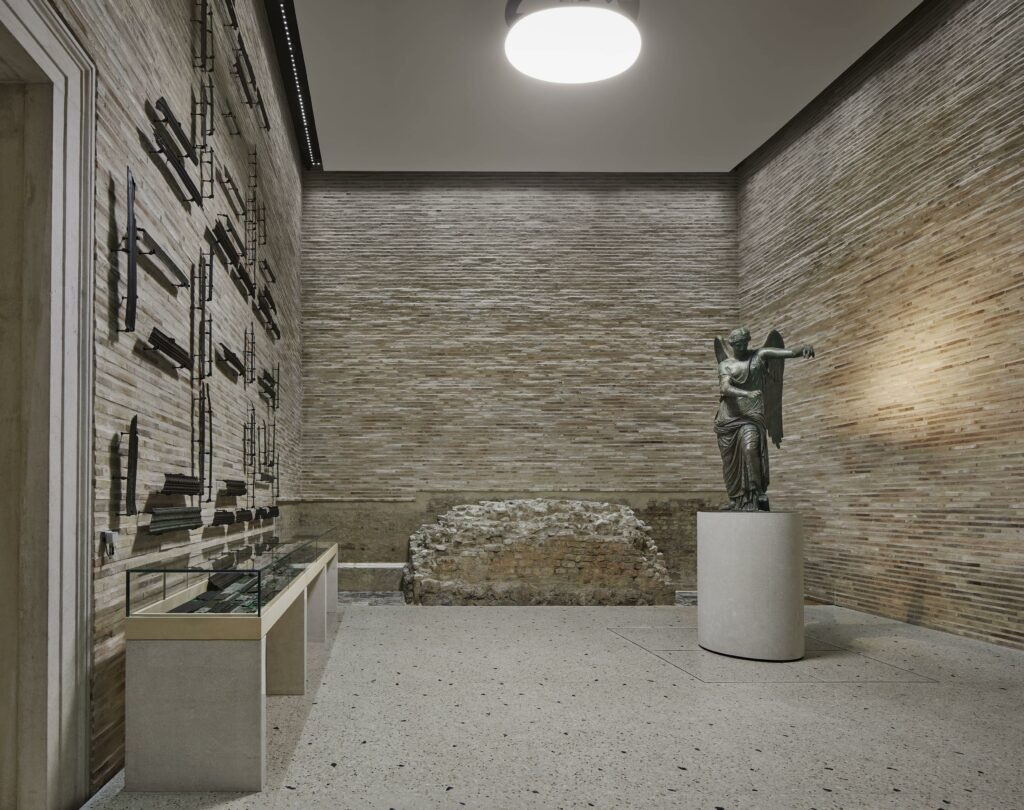
After a long period of city celebrations, the Vittoria Alata has returned to Brescia; welcoming it is a new museum venue, the eastern hall of the Capitolium, featuring an installation designed by the Spanish architect Juan Navarro Baldeweg, who is at the forefront of international museotechnics in terms of conservation, systems, and lighting technology.
The reinstallation project is part of the program Vittoria Alata Brescia 2020, a widespread cultural palimpsest promoted by the Municipality of Brescia and the Fondazione Brescia Musei, which involves various fields: archaeology, ancient art, contemporary art, theater, and photography. The visual identity of the entire palimpsest was developed by Studio Tassinari/Vetta, which is also responsible for the stamp issued in November 2020.
The installation of the Vittoria Alata was preceded, starting from September 18, 2020, by the tribute exhibition Juan Navarro Baldeweg. Architecture, Painting, Sculpture. In a Field of Energy and Process within the museum path of Santa Giulia (Coro delle monache, Basilica di San Salvatore, and the underlying crypt), to present to the city and museum visitors the sensitivity and creative strength of this architect, one of the most original in the contemporary international scene, as well as the author of the reinstallation project of the Capitolium.
Since October 27, 2020, the work Incancellabile Vittoria, a permanent monument inspired by the Vittoria Alata created by the Sicilian artist Emilio Isgrò, has been installed on the north wall of the “Stazione FS” stop of the Brescia Metro and donated to the city of Brescia.
With the public inauguration of the restored Vittoria Alata, the palimpsest will be enriched with further important initiatives: the show Calma Musa Immortale. In the Footsteps of the Vittoria Alata developed by the Centro Teatrale Bresciano, the unprecedented photographic exhibition Alfred Seiland. IMPERIVM ROMANVM as part of the IV edition of the Brescia Photo Festival, the spectacular curatorial interventions by Francesco Vezzoli, the tribute exhibition Vittoria. The Long Journey of a Myth, and a retrospective of Emilio Isgrò on the occasion of the celebrations for the tenth anniversary of the recognition of the Brescia UNESCO site.

For more information and insights, visit the site www.vittorialatabrescia.it and www.bresciamusei.com