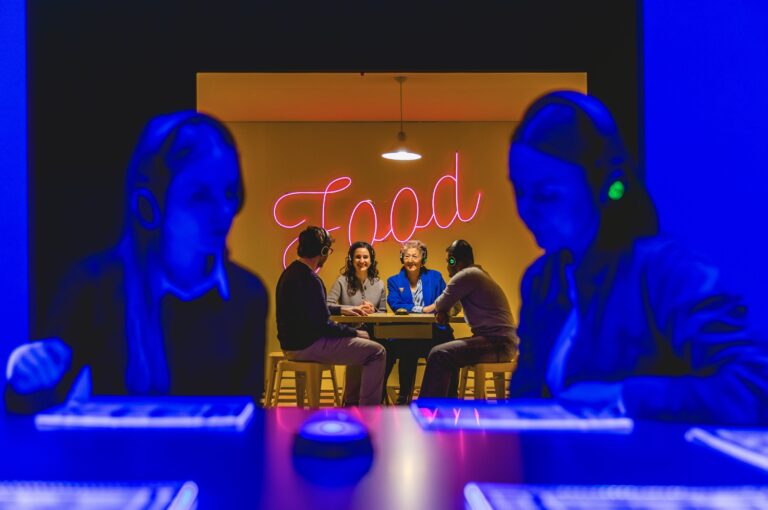
Just a few steps from Piazza di Spagna, wandering through the streets of the historic center, one can stumble upon a small gem of contemporary art: Fondazione Memmo, a significant presence in the Roman art scene. On January 15, it inaugurated the sixth installment of the exhibition series Conversation Piece. Reality is what does not disappear when you stop believing in it, dedicated to artists Corinna Gosmaro, Philippe Rahm, and Rolf Sachs, winners of scholarships at the American Academy in Rome, the French Academy – Villa Medici, and the German Academy of Villa Massimo.
The New Realism
The works are displayed in “conversation” with each other around a shared theme: The new realism. To understand them more deeply, we think it might be useful to dedicate a few minutes to the philosophical question that the artists have chosen to interpret. Let’s try to grasp the thoughts of the Italian philosopher Maurizio Ferraris and his manifesto of “new realism.” The artists’ reflection indeed revolves around the statement that is also the subtitle of the exhibition: Reality is what does not disappear when you stop believing in it. This statement aims to assert that there must exist an objective reality outside of our personal beliefs and that “reality is not infinitely manipulable.”

Maurizio Ferraris
This is what Maurizio Ferraris argues in the theories of New Realism, a contemporary philosophical movement that marks a true change of season compared to some “dogmas” of Postmodernism according to which “there are no facts, only interpretations.”

“There is a reality independent of what we think and know!” asserts the philosopher, providing an easily understandable example:
“If I take a glass of water today, I know it is H2O. Last century, it was not known; in a century, it may be called something else, but its properties will remain the same, whether I know it or not.”
However, in this historical period, we are often convinced that what we know coincides with true reality; our interpretation or what we have heard about a fact corresponds to the truth even when it does not, “this is why we find ourselves in a world where different cultures share different worlds and there is no common ground.” “The world of illusions favors great illusionists,” he adds. The construction of reality is in the hands of those who have the power to do so: the media, politics, the powerful. The society of mass communication has created an artificial reality, discrediting knowledge in favor of illusion and presenting reality transformed into reality TV.

The Critique
How can we defend ourselves from all this? Only critique will allow us to ascertain reality instead of accepting it as it is presented to us. We must “use critique to combat the anti-realism of government artists, thus avoiding becoming followers of a reality constructed by others.” You may be wondering what all this has to do with art and the works on display in Conversation Piece?
All the works rely on the concreteness of real objects. These objects, which often populate our everyday lives, can confront us, thanks to their concreteness, with the evidence of a more objective reality that is less subject to personal interpretations? Can they bring us closer to the artist’s thought through the familiarity we feel towards them? Can clothing items make us reflect on an issue, such as climate change? Or can photographs taken during the inauguration, transformed into artwork, become testimony and evidence of the fact that… I was there!?

If you want to discover it, arm yourself with Critica and visit Conversation Piece pt. VI! For those who wish to delve deeper into Ferraris’ theories, we invite you to consult the link, which has been very helpful in understanding his thought.
http://www.raiscuola.rai.it/articoli/il-manifesto-del-nuovo-realismo/14692/default.aspx
At the entrance, before you go in, shed all your preconceptions and watch out for recycling…