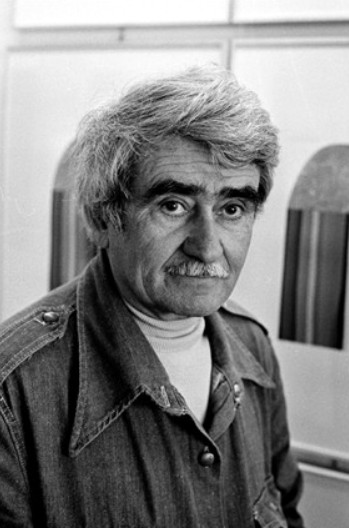
Alberto Burri is one of the leading artists of the second half of the 20th century in Italy.
He was born in Città di Castello, in Umbria, in 1915 and graduated in medicine. He was drafted in 1943 with the rank of second lieutenant doctor and was then sent to North Africa.
After returning from 18 months of captivity in the United States, he began to dedicate himself to painting, moving to Rome.
International success came in the early 1950s with his first solo exhibitions in America.
The Ex Tobacco Dryers in Città di Castello
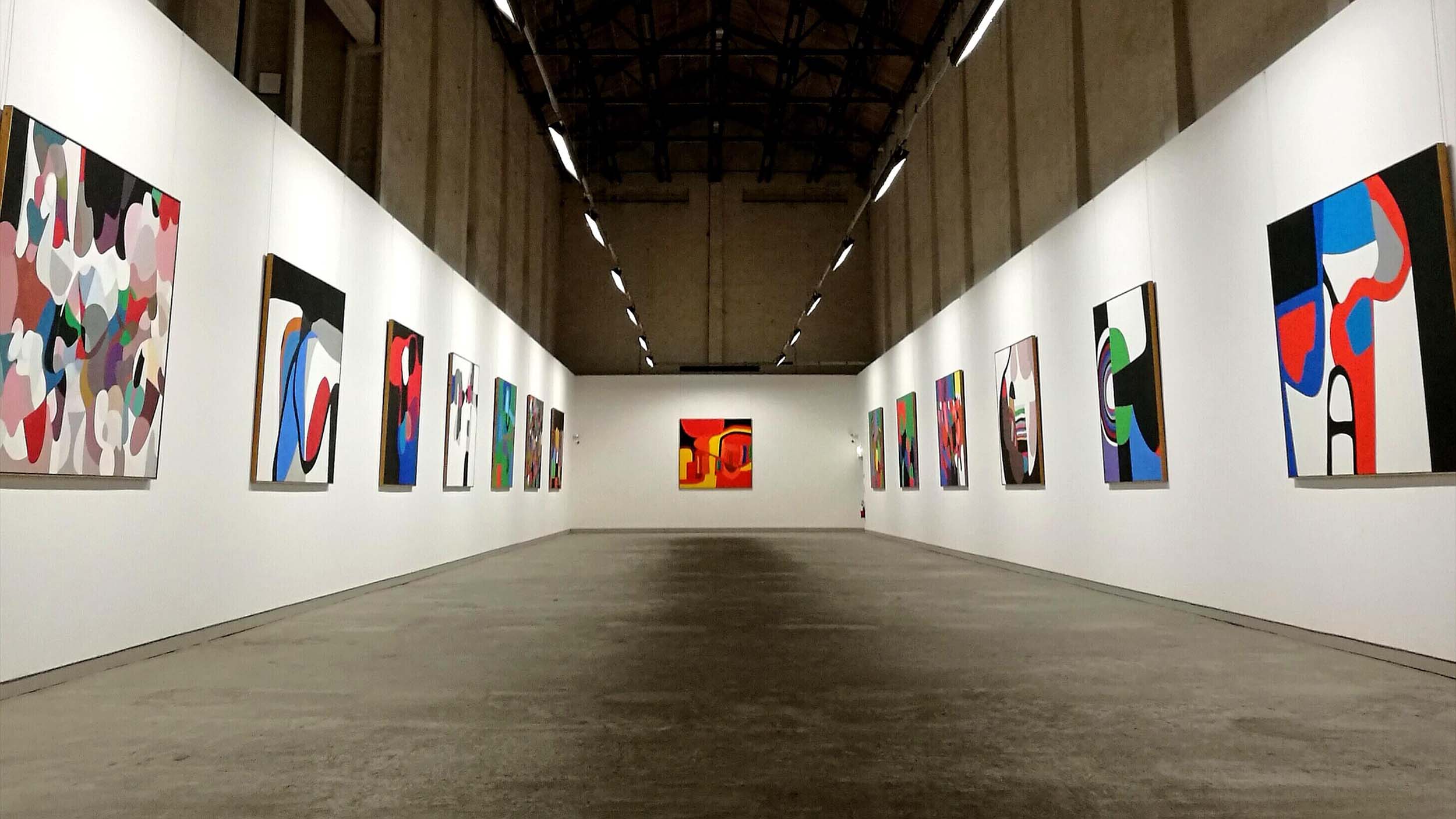
If there is a place to discover Burri’s art, it is the Ex Tobacco Dryers in Città di Castello.
This is a gigantic industrial complex, previously used as a factory for drying tobacco, which Burri himself identified as the ideal space to establish his studio and, with great foresight, immediately understood it could also become the right place to permanently exhibit his works.
Burri’s works were already displayed at Palazzo Albizzini, the first headquarters of his Foundation since 1981, still open to visitors today. However, given the increasingly larger dimensions that the works were gradually assuming, the artist decided to purchase and renovate these new spaces.
The Works of the Ex Tobacco Dryers
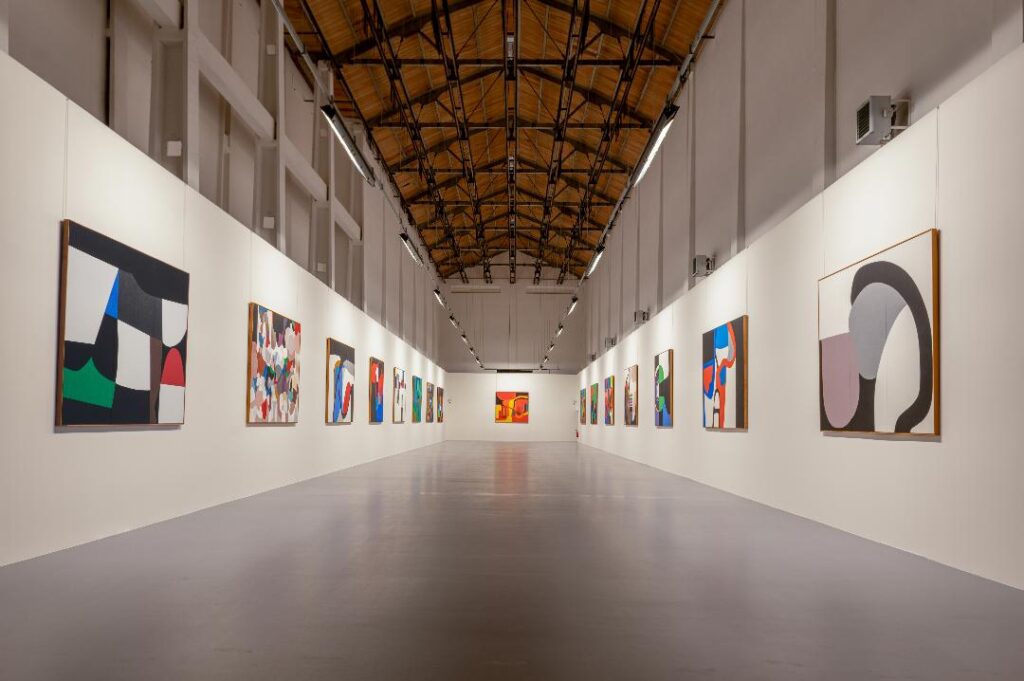
At the Ex Tobacco Dryers, 128 works are on display, arranged according to the indications given by Burri himself at the time, collected in cycles, as they can only be understood in their entirety.
Among the works, there are also four large sculptures, one located inside, and the other three placed in the garden in front of the Dryers. A common characteristic of all the exhibited paintings is the cellotex, a thermally insulating and sound-absorbing wooden mixture that Burri had been using since the beginning as a support and which he began to show on the surface in the 1970s.
In which other museums can Burri’s works be found?
In the section Burri around the world at the Ex Tobacco Dryers, you can see all the institutions and museums around the world where his works are exhibited.
In Italy:
- Modern Art Gallery, Mambo, P.zza Costituzione 3, Bologna
- Magi ‘900 Museum, Via Rusticana, 1, Pieve di Cento, (BO)
- Gallery of Modern and Contemporary Art, Accademia Carrara, Via San Tomaso 53, Bergamo
- International Museum of Ceramics, Viale Baccarini, 19, Faenza (RA)
- Cabinet of Drawings and Prints of the Uffizi, via della ninna, 5, 50122, Florence
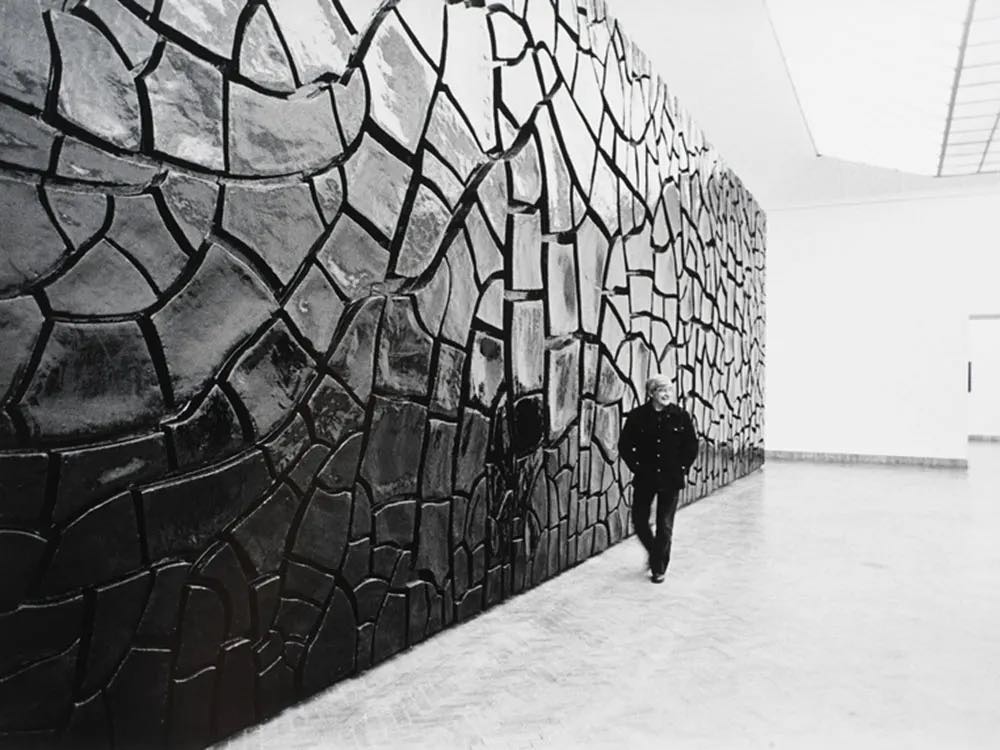
- Grande Cretto Gibellina, Gibellina (TP)
- Teatro Continuo, Sempione Park, Milan
- Capodimonte Museum, Via Capodimonte, 80131 Naples
- Academy of Fine Arts, P.zza San Francesco al Prato, 06100 Perugia
- Modern and Contemporary Art Gallery of Riccione, Villa Franceschi, Via Gorizia, 2, Riccione
- National Gallery of Modern Art, Viale Belle Arti 131, 00197 Rome
- Mart, Corso Angelo Bettini, 43, Rovereto
- Fattoria di Celle Gori Collection, Santomato di Pistoia
- Palazzo Collicola Visual Arts, Piazza Callicola, 1, 06249, Spoleto
- Civic Gallery of Modern and Contemporary Art, Via Magenta 31, Turin
- Foundation for Modern and Contemporary Art- CRT, Via XX Settembre, 31, Turin
- Civic Museum Revoltella and Modern Art Gallery, Via Diaz, 27, Trieste
EUROPE
- Museum of Fine Arts, Budapest
- Royal Museums of Fine Arts of Belgium, Brussels
- North Rhine-Westphalia Art Collection, Düsseldorf
- Kaiser Wilhelm Museum, Krefeld
- Tate Gallery, London
- State Gallery of Modern Art, Munich
- Centre Georges Pompidou, Paris
- Museum of Contemporary Art, Skopje
AMERICA – ASIA
- Albright-Knox Art Gallery, Buffalo
- National Museum of Fine Arts, Buenos Aires
- Art Institute, Chicago
- Dayton Art Institute, Dayton
- Museum of Fine Arts, Houston
- Franklin D. Murphy Sculpture Garden, University of California, Los Angeles
- Fogg Art Museum, Harvard University, Cambridge, Massachusetts
- The Solomon R. Guggenheim Museum, New York
- The Museum of Modern Art, New York
- Smith College Museum of Art, Northampton
- Museum of Art, Carnegie Institute, Pittsburgh
- The Glenstone Foundation, Potomac
- San Francisco Museum of Art, San Francisco
- Kemper Art Museum, Washington University, Saint Louis
- Toyota Municipal Museum of Art, Toyota
- National Gallery of Art, Washington