Sospesi opens in Milan from March 20 to 23, 2025. The exhibition, previously displayed in Rome and curated by Serena Tabacchi, showcases the works of Massimo Vitali and Jacopo di Cera.
A few weeks ago we met Jacopo. Here’s what he told us.
In “Sospesi”, the aerial photography reflects the main theme of the exhibition, which is suspension. We find ourselves in front of an elevated point of view. What sparked your interest in this perspective? How did you start taking similar photographs?
I started working in the project field about 20 years ago, initially through the path of photo materism, which consists of the union of image with matter.
In this sense, my most important project was “Fino alla fine del mare”, which, always with a social eye, focused on the abandoned migrant boats of Lampedusa on the beach. I began to photograph the details of these boats.
The change of perspective happened on a specific day: when I decided to buy one of those drones of which I understood very little at the time.
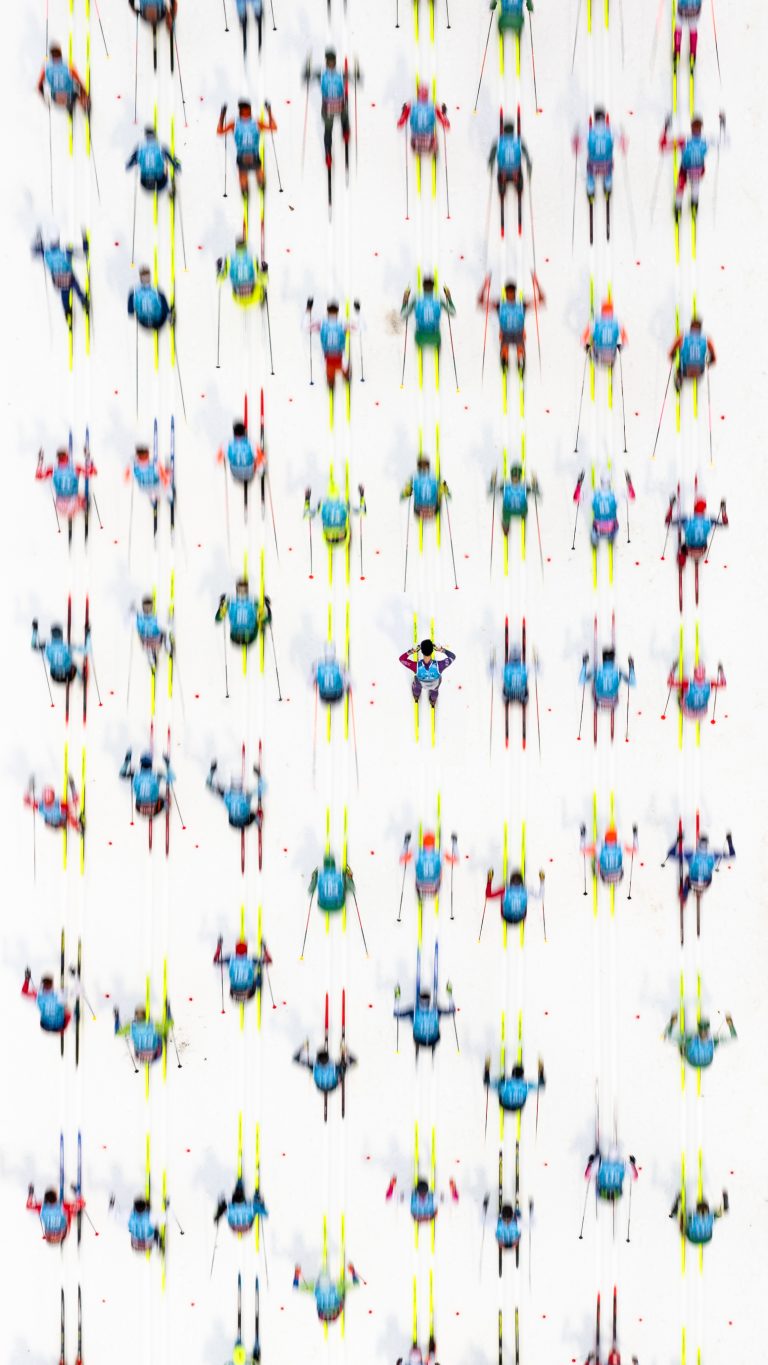
Since I was in Procida and saw many boats, I wondered how they looked from above: at lunchtime they all came together, and it was very amusing because, from above, this coming together transformed into a sense of community. I then realized that this perspective offers interesting viewpoints that often even the brain cannot imagine. It was 2015, and from then on, the desire was born to tell not only about summer or winter but in general Italianity, how we Italians experience certain moments of gathering such as a lunch at the sea, a race, a party, or a championship.
By shooting from above, all the subjects portrayed appear on the same level; no one is more important than the other. Can we say there is a sort of “democracy” in your photographs?
Yes, this sense of democracy in the photos is another aspect of the social research I mentioned earlier. There are no classes, there are no territorial limits and, sometimes, the territory intervenes in social dynamics. There are no more borders. The image loses its depth and becomes almost 2D; there is a flattening that creates a perception for the viewer that is totally different from “normal” images.
It’s also interesting to note the contrast between this aerial perspective, which is more generalist, and Massimo Vitali’s more detail-oriented approach. Can you tell us more about how they interact?
In reality, we have a lot in common. Massimo started this research 30 years ago, but the social analysis is identical. We are both on the same path of social and artistic research, and the beautiful thing is the two different but equally suspended points of view. He enters the photo and becomes part of it, immersing himself in the scene, which consequently returns more details; I experience it from above and, perhaps, in a detached manner, although there is no judgment. These two approaches interact well; we often photograph the same places (even at different times) and provide two complementary readings.

Who are your references in photography and art history?
During my student years in Rome, at the Officine Fotografiche, my main teacher, who is still my curator today, was Massimo Ciampa. I also had the opportunity to deepen my studies with various artists and photographers, and the one who completely changed my life was Oliviero Toscani. With him, I attended a very demanding ten-day workshop, where he encouraged us to bring different viewpoints, abandoning the habit of escaping, but rather giving an emotional motion to our shots. With him, I began to give a projectuality to my photographs, meaning that whenever I started something, there was then the desire to continue telling. Toscani has certainly been an inspiration and a guide for a different vision of photography and art in general. Then, reflecting on the images, we are still talking about an artist (ref. Toscani) who taught us to take away rather than add.
Other names I can mention of photographers who inspired me include Ugo Mulas. In his books and stories, with his simplicity, he taught us many things, such as that you don’t have to go far to find stories that need narration.
In art in general, I consider myself a groupie of Chagall: if I need to calm down today, I look for his flights, his colors, and his dreams because they have a lot of power over me, even though they are not always images linked to positivity.
In cinema, I assisted a photographer named Fabian Cevallos who photographed all the Hollywood stars. One day I asked him for books to study, we were in his studio in Umbria, and he gave me a book on Caravaggio, telling me: the greatest photographer you can learn from is him. We discussed a lot about the use of light in Caravaggio.
If you could choose, what other places besides Italy would you like to capture from above?
For my personal fascination, I am waiting for the right moment to go to Iceland, where there is this triptych of the white of ice and snow, the black of ash, and the red of lava. Nature certainly tells us many things.
In reality, for now, I am more focused on the theme of shadows because it is a work I have been doing for some time; even in my winter works with snow, the perspective changes; but that is another path, the souls I capture manifest themselves in a completely different way. There are no longer people lying on the beach but standing, doing things, and casting shadows on the snow. A totally different sociality is created.
On Artsupp you will find the city's full calendar with opening hours and tickets.
Explore Milan