RECOVERY OF A PAINTING MISSING FOR OVER A HUNDRED YEARS
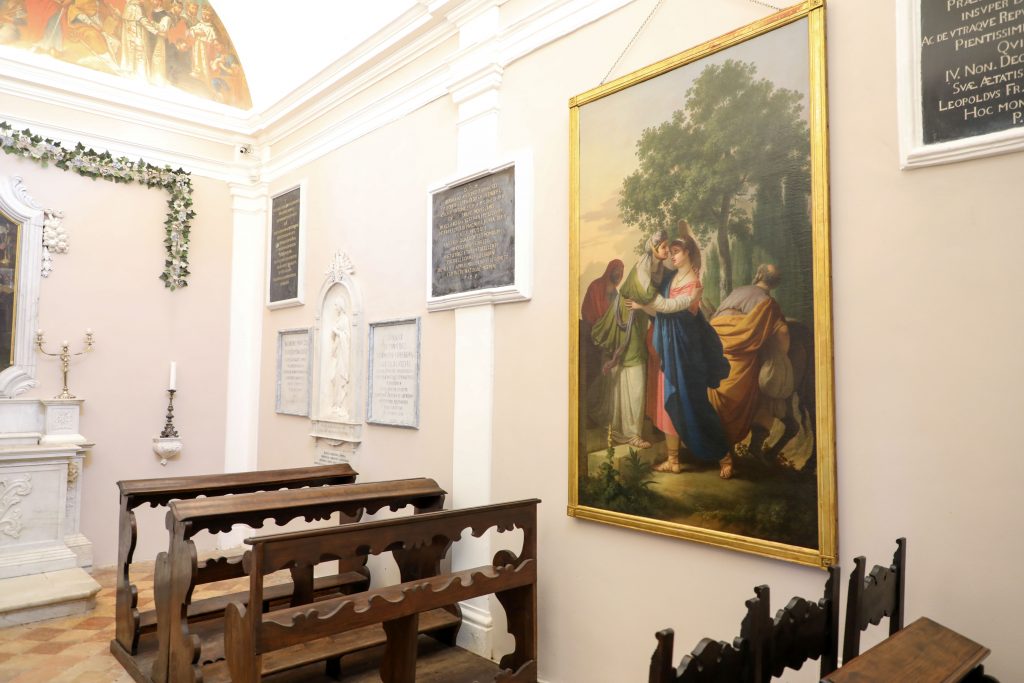
Thanks to the collaboration of the Superintendency of Archaeology, Fine Arts, and Landscape of Friuli Venezia Giulia and the decisive intervention of the Carabinieri of the Cultural Heritage Protection Unit in Udine last May, after more than a hundred years, a work that had completely disappeared during World War I has returned to Palazzo Coronini Cronberg: the Visitation by the painter Francesco Caucig (1755-1828).
An internationally renowned painter
The name of Francesco Caucig, now considered one of the protagonists of European Neoclassicism, may not be very well known to the general public, but he enjoyed great appreciation among his contemporaries, and his personal story is closely linked to the history of the Coronini Cronberg family.
Born in Gorizia in 1755 to parents of Slovenian origin, he was soon noticed for his talent by Count Guidobaldo Cobenzl, who recommended him to his son, Giovanni Filippo, who was embarking on a brilliant political and diplomatic career at the court of Vienna, where Caucig was sent to continue his studies at the Academy of Fine Arts. In the following years, he spent a long time in Italy, in Bologna and especially in Rome, where he cultivated his passion for ancient art and the great masters of the Renaissance, mingling with some of the most important artists of the time such as Pompeo Batoni, Felice Giani, Angelica Kaufmann, and Antonio Canova.
Returning to Vienna in 1787, he began to receive commissions from influential aristocratic families, creating works on religious subjects, but more often on historical, mythological, or allegorical themes. His activity took him to Mantua, to Venice, where he settled for seven years, and then back to Vienna with the prestigious position of professor of history painting at the Academy.
From Vienna to Gorizia: the paintings of the Cobenzl chapel
Caucig’s career took place mainly between Austria, Germany, Hungary, and Bohemia, and it was for the chapel of his patron Giovanni Filippo Cobenzl’s villa in Reisenberg, near Vienna, that he executed around 1800 a series of canvases depicting stories from the life of Mary. Upon the death of Count Cobenzl in 1810, three of these paintings were inherited, along with his entire estate, by Count Michele Coronini Cronberg and thus arrived in Gorizia.
As confirmed by local historians, one, depicting the Assumption of the Virgin, was placed on the altar of the chapel of Cronberg Castle, the main residence of the Coronini counts now in Slovenia, while the other two, featuring the Visitation and the Flight into Egypt, were placed in the chapel of Palazzo Coronini Cronberg in Gorizia.
All three paintings, which constituted the only evidence of Caucig’s work in his hometown, disappeared during World War I. The Assumption was damaged due to reckless rolling that harmed the painted surface. Only a few fragments remain, which Count Guglielmo Coronini had restored in the 1950s. The best-preserved one, featuring a cherub, is now displayed in a room of the Palazzo. The other two canvases by Caucig, however, completely lost track during the conflict, as noted in numerous publications released in the following years, which, however, do not provide any indication of the circumstances of their disappearance.

The disappearance during World War I
The fate of the two paintings has recently come to light thanks to information provided by some documents preserved in the Coronini Cronberg Historical Archive and in that of the Superintendency of Archaeology, Fine Arts, and Landscape of Friuli Venezia Giulia.
When the Italian army conquered the city in 1916, the same protection and safeguarding plan for historical, artistic, and library assets that had been implemented since Italy’s entry into the war in all centers closest to the front was immediately put into action in Gorizia. This plan, conducted under the direction of the renowned art critic Ugo Ojetti, involved the removal of assets and their transport to safe locations beyond the Apennines, especially to Florence and Rome. This fate also befell the library and artworks owned by the Coronini, who had hastily abandoned their residence under the bombardments.
In 1919, a close collaborator of Ojetti, art historian Giorgio Nicodemi, personally returned to Count Carlo Coronini, the father of the last descendant Guglielmo, “all the artistic and bibliographic materials saved to protect them from the dangers of war under the care of the General Secretariat for Civil Affairs of the Supreme Command of the Italian Royal Army. With the exception of two canvases by Caucig, for which a search will be made at the Royal Gallery of the Uffizi where the two paintings were deposited.”
What the two Caucig paintings were is better specified by Count Carlo himself in a letter sent on December 2, 1919, to the Royal Commissioner for Venezia Giulia in Trieste: “in November 1917, many art objects recovered in Gorizia were sent from Gorizia to Udine. Two paintings by the well-known Gorizian painter Caucig are also mentioned in an official list (one depicted the meeting of Mary and Elizabeth, the other the flight into Egypt, and both were of the same large format) […]. The aforementioned paintings were located in the chapel of Graffenberg (Zingraf) in Gorizia and belong to my parents […]. Many paintings and other objects saved in Florence were returned, and it is unclear how the aforementioned two paintings, which were also on the list of salvaged items, could have gone missing.”
In the following weeks, the Trieste authorities indeed conducted searches in Florence, Rome, and Venice, but, as they wrote to Carlo Coronini on February 20, 1920, without any results. Nothing was known about the two paintings by Caucig… until a few months ago.

The Discovery and Recovery
In December 2020, an art historian interested in Caucig’s works reported to the Coronini Cronberg Foundation that one of the paintings previously housed in the chapel of the Gorizia Palace had appeared on the antique market, providing photographic evidence of the work. With documents detailing the story of the disappearance and the report made to the authorities at the time by the Coronini counts, the Foundation believed there were sufficient grounds to claim ownership of the painting as the legitimate heir of the Coronini counts.
After initial contacts with the relevant Superintendency, which immediately supported the Foundation’s request and allowed the discovery of other documents related to the case in its archives, the investigations were passed to the Cultural Heritage Protection Unit of Udine, which, after identifying the altarpiece in an art gallery in Rome, in collaboration with the Rome Unit and the special Superintendency of the capital, arranged for its seizure by the Public Prosecutor’s Office of Rome. The same judicial authority subsequently issued a decree for the release and return in favor of the Coronini Foundation. In May, the painting thus returned to Gorizia and was relocated in the chapel of the Coronini Palace from which it had been removed more than a hundred years earlier.
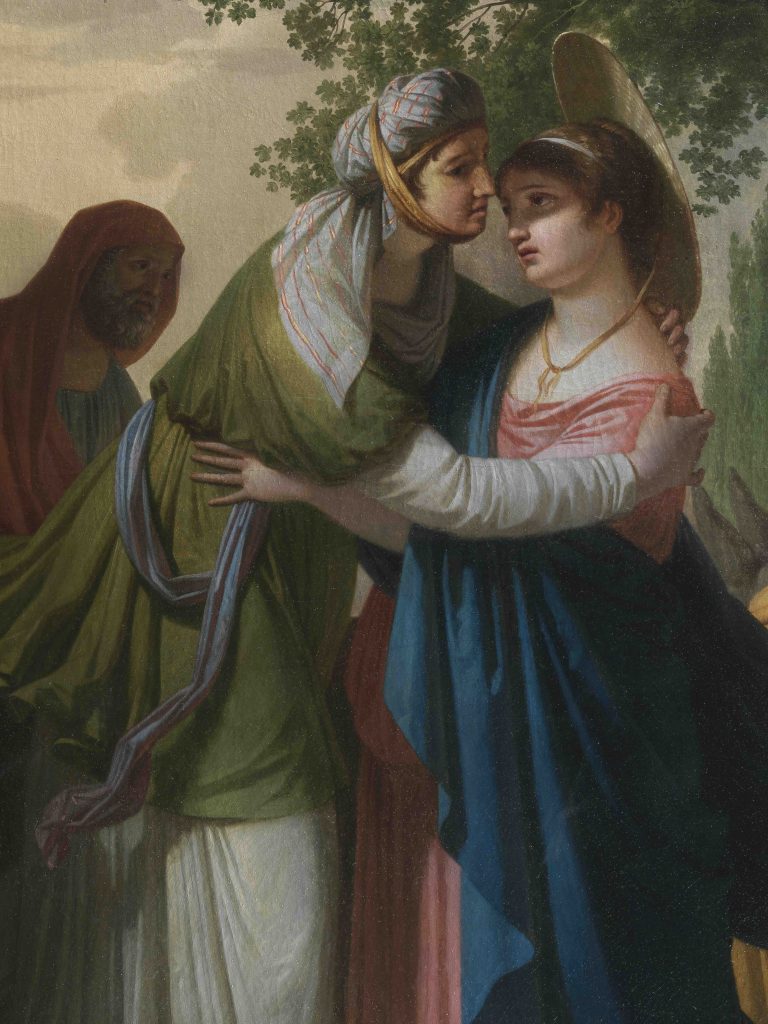
A Healed Wound
The reappearance of the Visitation by Caucig, whose loss was felt at the time as a wound deeply affecting the history of the city and one of its most illustrious sons, today holds a significant symbolic meaning for the Foundation. At a time when Caucig did not yet enjoy the international recognition he has achieved in recent decades, Count Guglielmo Coronini was already intent on enhancing his figure, not only for his Gorizian origins but also for his connection with the Cobenzl family, whom he considered part of his own family, as evidenced by the fact that in the early 1960s he purchased a substantial corpus of the artist’s drawings at the Academy of Vienna, still preserved in the Foundation’s collections.
For this reason, in the coming years, the Foundation will certainly commit to promoting and enhancing the figure of this artist, who never worked in his hometown but always signed his works as “Francesco Caucig Goriziano” and who is also remembered on his tombstone as “FR. CAUCIG PICTOR EGREGIUS GORICIUS.”