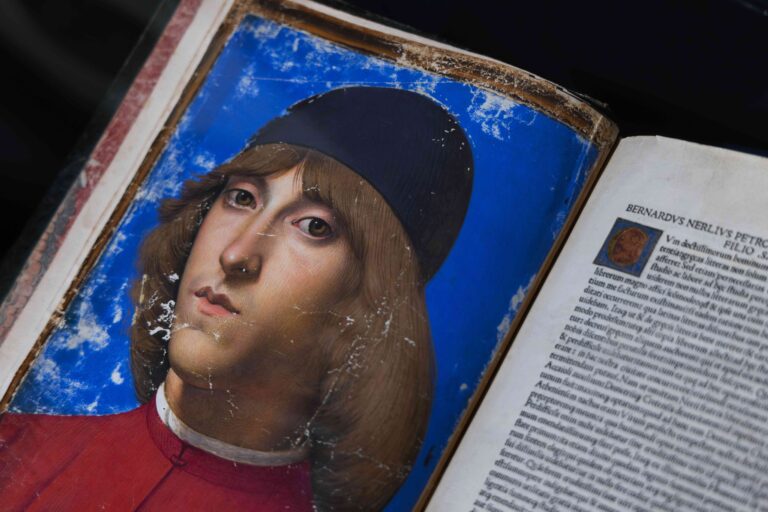
Towards Narragonia is the title of the seventh edition of the group exhibition Conversation Piece, hosted in the exhibition spaces of the Fondazione Memmo from February 8 to July 1, 2021. The title alludes to a mythical place, Narragonia, described by the Alsatian writer Sebastian Brant in the satirical poem The Ship of Fools (Das Narrenschiff), published in 1494. The book recounts the wanderings of a vessel packed with characters considered mad, nonconformist, marginalized, and unwanted: Narragonia is the unhappy and never-reached destination of this ship of exiles, abandoned to their fate, devoid of guidance and thus destined for shipwreck, both real and symbolic. In the text of The Ship of Fools, a varied humanity is sketched, in which every deviation from the norm or morality, every form of otherness or presumed deviance is liable to be labeled as madness.

Starting from the consideration of the fluidity of the concept of “madness” throughout history and the negative connotation given to it in Brant’s poem regarding the Stultifera Navis, Michel Foucault promotes a reversal of this moralizing paradigm: in History of Madness in the Classical Age, published by Foucault in 1961, the distancing of what is different, of the disturbing elements for the established order, represents a form of coercion available to the establishment to suppress dissenting voices or unorthodox behaviors. In this perspective, mad is one who stands outside a system, who criticizes it, who adheres to a principle of otherness.
It is in this subversive potential of “madness” and in the germ of creativity inherent in it that lies the interpretative key of the seventh edition of Conversation Piece, curated by Marcello Smarrelli, which sees artists of different nationalities, all connected to Rome, engaging with the themes of eccentricity, the deformation of reality, and the uncanny, in a historical moment that is both alienating and unprecedented, thus profoundly “artistic.”

The Artists
The featured artists each interpret the proposed theme according to their own grammar, creating a coherent narrative within the exhibition despite the diversity of the works presented. The exhibition path opens with the installation 23 Heads by the Belgian duo Jos de Gruyter & Harald Thys: a “Lombrosian” gallery of severed heads, a desecration of madness and the grotesque through which to normalize characters that are more or less uncomfortable, perverse, and in some cases evil, but all with “shadows.”

Following is the painting by Apolonia Sokol, in residence at the French Academy of Villa Medici. Her work is an immediate and explicit reworking of the subject of the Ship of Fools, according to a contemporary and personal interpretation: her fools are real people, connected to the experiences and daily reality of the artist, but filtered through the distorting gaze of the observer. The presented work is sensitive to the demands of intersectional feminism, showing us a heterogeneous array of figures in which the concept of femininity is extended to embrace a broad category, not defined according to an exclusively biological criterion.

Closing the exhibition is the work of Benedikt Hipp, an artist from the German Academy of Villa Massimo, where architecture, sculpture, and painting are skillfully integrated: dismembered, residual organic forms, close to the dimension of the “figurative,” compose a complex play of dissections and assemblages, generating a restless, dark, and disturbing psychological landscape.

Sebastian Brant, Stultifera navis mortalium, in qua fatui affectus, mores, conatus atque studia, quibus vita haec nostra, in omni hominum genere, scatet, cunctis sapientiae cultoribus depinguntur, & velut in speculo ob oculos ponuntur, Basel, Sebastian Henricpetri, 1572. Biblioteca Oliveriana, Pesaro. 
Benedikt Hipp, Plastizität als Voraussetzung, 2020. Oil and enamel on MDF wood. 104 x 76 cm. Courtesy: Monitor, Rome Lisbon Pereto; Kadel Willborn, Düsseldorf; the artist.
Ph Credit: Daniele Molajoli