The history of art is full of symbolisms.
Over the centuries, works have been enriched with the representation of certain objects considered symbols of life, death, fertility, beauty, fidelity, and so on.
Below we tell you about some objects in art.
The coral
The coral has always been considered an extremely precious and sought-after material.
In sacred art, according to studies, it indicates religion – particularly the passion of Christ for its red color and branched shape that resembles blood vessels – and acquires apotropaic meaning.
For this reason, coral has also become an amulet to ward off hostile forces, especially the evil eye.
It is interesting to note the connection of its meanings with the very etymology of the word, which derives from the Greek “koraillon” meaning “hard skeleton,” or from the Hebrew “goral“, literally “stone with oracular powers.” Definitely a magical object.

The pomegranate
The pomegranate is another well-known symbol among objects in art.
Pomegranate from Latin malum (apple) and granatum (with seeds) is a red fruit, shaped like an apple but with internal seeds.
If one thinks of the pomegranate, it is likely associated with the figure of Bacchus, from whose blood – according to myth – it originated.
The pomegranate, used in both Western and Eastern cultures, generally assumes the meaning of fertility.
Not by chance, in ancient Greece, the pomegranate was a sacred plant to Venus and Juno, considered the protectors of marriage and fertility.
Numerous paintings depict these deities holding a pomegranate in their right hand.

The shell
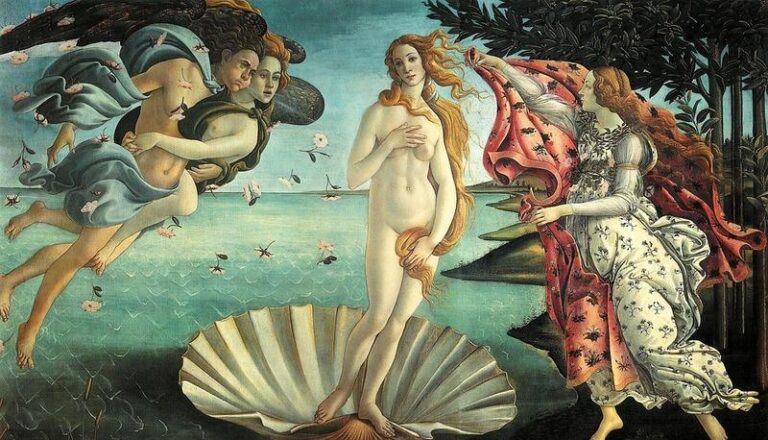
The shell is a symbol of rebirth and fertility: how can one not think of Botticelli’s Venus.
The goddess who is born from a shell and is carried by the sea.
In Roman mythology, it is said that Venus, the goddess of love and fertility, was created from the foam brought to shore on top of a shell.
For this reason, the shell is a symbol of the feminine divinity in pagan worship, and later of love, birth, and reproduction.
Many paintings representing Venus therefore depict a shell to identify her.

The egg
The egg is one of the most represented symbols in the history of art.
It encompasses a true set of symbolisms that traverse all eras.
Starting from the Renaissance with the Pala di Brera by Piero della Francesca to the works of Piero Manzoni, Lucio Fontana, Salvador Dalì, Man Ray, Jeff Koons and many others.
The egg, in any case, remains the quintessential symbol of birth and rebirth, fertility, growth and evolution, but also of the perfection of Nature.

The dog
The dog, man’s best friend and the most depicted animal in the history of art.
Its representation in art has ancient origins: we find it even in the cave drawings of primitive times. The symbolism it carries is that of loyalty, a gentle and noble spirit always close to man.
To grasp the importance this animal has had, one only needs to think of ancient Egypt where the God Anubis had a face resembling that of a dog.
Later, the dog was also depicted by Titian in the Venus of Urbino, by Jan Van Eyck in the Arnolfini Portrait, by Giacomo Balla with his dynamism, and even by Andy Warhol, the soul of Pop Art.